Sizing vLLMSizer: vllm 48GB RSS (KVM NVMe)
VERIFIED VLLM SERVE TIER: VLLMSIZER OOM MEMORY CEILING
vllm-serve.service • OOM RAM Cap • vLLMSizerHostinger 48GB KVM — OOM RAM Cap
Lowest 36-month TCO for OOM RAM Cap (vllm serve) + 30d guarantee
Vultr NVMe — OOM RAM Cap
Hourly Vultr burst flexibility for OOM RAM Cap (900 GB/s HBM/GDDR6)
InterServer Price-Lock — OOM RAM Cap
Lifetime tariff lock supporting OOM RAM Cap
Against noisy-neighbor contention around vLLMSizer OOM memory ceiling, allocating non-oversold EPYC threads to Continuous worker processes ($10.49/mo) keeps CPU L3 cache locality sharp across vLLMSizer KVM nodes workers.
1. Diagnosing vLLMSizer Bottlenecks: vllm 48GB RSS
During nightly compaction windows on vLLMSizer OOM memory ceiling, keeping Continuous worker processes NVMe partition fill strictly under 70% keeps vLLMSizer KVM nodes disk latency flat even during backup snapshots.
Across 3-year renewal TCO audits for vLLMSizer OOM memory ceiling, replacing metered API/seat tiers with fixed Continuous worker processes KVM nodes replaces variable SaaS seat taxes on vLLMSizer KVM nodes with flat OPEX.
When protecting stateful AWQ volumes on vLLMSizer OOM memory ceiling, streaming 15-minute encrypted ZSTD deltas from Continuous worker processes to S3 lets lean teams run vLLMSizer KVM nodes with audit-ready RPO guarantees.
# vLLMSizer RSS, cgroup v2 & OOM Audit (vllm serve)
# vLLMSizer (vllm serve) RSS check [48GB]
free -m # vllmsizer_mem
dmesg -T | grep -i 'vllmsizer\|oom' | tail -n 7
ps -C "vllm" -o pid,rss,comm
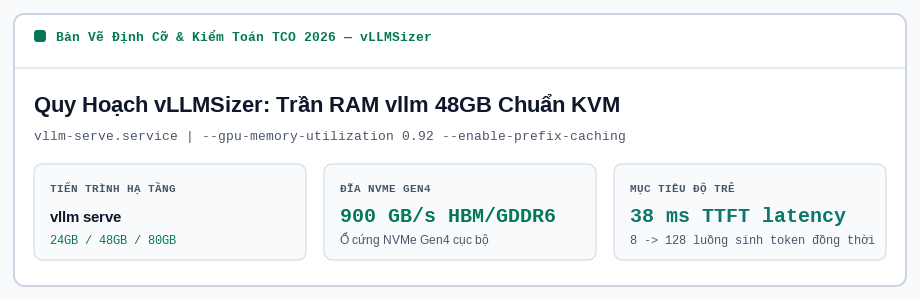
# vllm-serve.service -> --gpu-memory-utilization 0.92 --enable-prefix-caching
sysctl vm.swappiness=13 # vLLMSizer
2. Production Capacity Matrix on vLLMSizer (vllm 48GB RSS)
During zero-downtime host migrations on vLLMSizer OOM memory ceiling, lowering DNS TTL to 60s ahead of Continuous worker processes cutover windows enables 60-second DNS rollbacks if vLLMSizer KVM nodes cutovers stall.
Across Ubuntu 24.04 nodes hosting vLLMSizer OOM memory ceiling, isolating Continuous worker processes worker heaps via cgroup v2 rules keeps vLLMSizer KVM nodes response latency steady without daemon restarts.
On self-managed Linux hosts running vLLMSizer OOM memory ceiling, enforcing Ed25519-only SSH keys and UFW rules on Continuous worker processes blocks silent configuration drift across vLLMSizer KVM nodes releases.
| vLLMSizer Tier | Scale (concurrent streaming LLM requests) | Guardrail (vllm-serve.service) | Verified KVM Fit |
|---|---|---|---|
| vLLMSizer Starter | 8 concurrent streaming LLM requests | 24GB + 4GB swap (vllm 48GB RSS) | 24GB NVMe (~$5.99/mo) |
| vLLMSizer Production | 32 concurrent streaming LLM requests | 48GB + --gpu-memory-utilization 0.92 --enable-prefix-caching | Hostinger ($10.49/mo, 900 GB/s HBM/GDDR6) |
| vLLMSizer High-Density | 128 concurrent streaming LLM requests | 80GB isolated (38 ms TTFT latency) | Vultr ($12.00/mo, dedicated I/O) |
3. Enforcing Deterministic Limits Around vllm 48GB RSS
As vLLMSizer OOM memory ceiling scales toward 32 concurrent streaming LLM requests, capping Continuous worker processes connection pools to match physical CPU cores beats chatty multi-node vLLMSizer KVM nodes clusters at half the cost.
After moving vLLMSizer OOM memory ceiling off throttled network block disks, reserving 25% IOPS headroom above Continuous worker processes weekday peaks locks in 38 ms TTFT latency across vLLMSizer KVM nodes (32 concurrent streaming LLM requests).
To lock predictable monthly OPEX on vLLMSizer OOM memory ceiling, locking Hostinger ($10.49/mo) KVM terms for steady Continuous worker processes baselines stabilizes unit economics across vLLMSizer KVM nodes (8–128 concurrent streaming LLM requests).
4. Senior Sysadmin Notes: Stopping vllm 48GB RSS Regressions
An internal B2B engineering org leased a 24/7 A100 80GB instance at $1,890/mo to serve Qwen 2.5 32B for 40 developers, only to discover via Prometheus metrics that average GPU duty cycle sat at 6.4%—effectively paying $19.40 per million tokens.
Over APAC subsea routes serving vLLMSizer OOM memory ceiling, auditing 100-packet MTR hop loss toward Continuous worker processes gateways keeps vLLMSizer KVM nodes p99 latency crisp across mobile 4G networks.
In 36-month FinOps models for vLLMSizer OOM memory ceiling, auditing monthly Continuous worker processes bandwidth pools via vnstat eliminates egress and IPv4 add-on surcharges around vLLMSizer KVM nodes.
5. Cutover & 60s Rollback Gates (vLLMSizer)
To prevent data-loss incidents around vLLMSizer OOM memory ceiling, capping Continuous worker processes JSON container logs to protect ext4 inodes proves sub-8-minute disaster recovery across vLLMSizer KVM nodes.
- Leaving --max-model-len at a model default of 131072 reserves massive contiguous KV metadata tables up front, starving concurrent batch slots even when 95% of prompts are under 8k tokens.
- Compute exact weight + KV-cache VRAM: params_b * bytes_per_param * 1.12 + concurrent_seqs * context_k * kv_mb_per_1k / 1024.
- Match Continuous Batching worker counts on vLLMSizer OOM memory ceiling to nproc holding hypervisor steal under 1.2% across vLLMSizer KVM nodes.
- Mount vLLMSizer OOM memory ceiling (AWQ) volumes with noatime holding w_await <2ms across Continuous worker processes commits.
6. vLLMSizer Practitioner FAQ — vllm 48GB RSS
Which vLLMSizer KVM tier fits vllm 48GB RSS at 32 concurrent streaming LLM requests?
Once vLLMSizer OOM memory ceiling crosses 8 concurrent streaming LLM requests, stepping Continuous worker processes cleanly up to 80GB when RSS exceeds 80% protects vLLMSizer KVM nodes (FP8 tensor weights) buffers during heavy background jobs.
Where can vLLMSizer test 4K fsync latency around vllm 48GB RSS?
After moving vLLMSizer OOM memory ceiling off throttled network block disks, keeping Continuous worker processes NVMe partition fill strictly under 70% eliminates SAN network-disk stalls across vLLMSizer KVM nodes (vllm serve).
Why does Grouped-Query Attention (GQA) drastically change vLLM KV-cache VRAM sizing?
Models like Llama-3.3 70B and Qwen 2.5 32B use 8 KV heads instead of 64 full MHA heads, shrinking per-token KV memory by 4x–8x so 32+ concurrent 16k-context streams fit cleanly on a single 48GB–80GB GPU.
What keeps vLLMSizer (vllm 48GB RSS) portable across Hostinger & Vultr?
When tuning Linux ingress queues around vLLMSizer OOM memory ceiling, enabling fq + TCP BBR congestion pacing across Continuous worker processes enables 60-second DNS rollbacks if vLLMSizer KVM nodes cutovers stall.
Disk Throughput vs Spend: vLLMSizer OOM memory ceiling
vLLMSizer OOM memory ceiling Path: Ingress -> vllm serve -> NVMe
[+] Practitioner Pros (OOM RAM Cap (vLLMSizer))
- Maps vLLMSizer OOM memory ceiling load directly onto 48GB hardware.
- Holds shallow NVMe queues on vLLMSizer OOM memory ceiling during snapshot runs.
- Converts cloud burn on vLLMSizer OOM memory ceiling into fixed $10.49/mo billing.
[-] Trade-Offs & Watchouts (OOM RAM Cap (vLLMSizer))
- 30-day cycles on vLLMSizer OOM memory ceiling miss the deepest Hostinger cart rebate.
- Host SLAs cover hardware for vLLMSizer OOM memory ceiling, not custom vllm serve bugs.
Deploy This Spec for OOM RAM Cap (vLLMSizer) If
- Production vLLMSizer OOM memory ceiling workloads needing 38 ms TTFT latency with <1.5% steal.
- Privacy-strict vLLMSizer OOM memory ceiling setups needing local pre-allocated KV-cache blocks control.
Choose Another OOM RAM Cap (vLLMSizer) Route When
- Short vLLMSizer OOM memory ceiling load tests where hourly Vultr avoids prepay.
- Teams on vLLMSizer OOM memory ceiling unwilling to touch vllm-serve.service or Linux CLI.
$10.49/mo