vLLM PagedAttention KV-Cache VRAM & Token Break-Even Calculator
Calculate GPU VRAM for model weights plus concurrent PagedAttention KV-cache—and see the exact break-even point between renting GPUs vs flat Token APIs.
Technical Specs & Formula (For Developers)
Size exact GPU memory across AWQ/FP8 weights and concurrent PagedAttention KV-cache blocks—while auditing the honest ~22% GPU duty-cycle break-even between dedicated Vultr Cloud GPUs and $0.18/1M Xiaomi MiMo serverless endpoints.
Eliminate both idle $1,800/mo 24/7 GPU waste and runaway commercial token bills by right-sizing single-card L40S/A100 vLLM deployments alongside serverless burst routing.

vLLMSizer PagedAttention KV-Cache VRAM & Token Break-Even Calculator
Adjust model parameters, AWQ/FP8 KV-cache quantization, concurrent sequences, context length, and GPU duty cycle to compute exact PagedAttention VRAM, check the ~22% Xiaomi MiMo ($0.18/1M) break-even, and copy production vllm serve CLI flags.
- Total vLLM VRAM
- Right-Sized Cloud GPU
- API Break-Even Threshold
- FinOps Recommendation
vllm serve Qwen/Qwen2.5-32B-Instruct-AWQ --quantization awq_marlin --kv-cache-dtype fp8| Memory Layer / FinOps Comparison | Deterministic Specification | Computed Output |
|---|---|---|
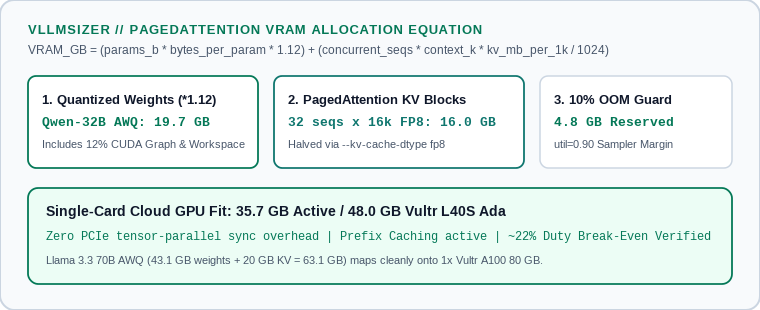
| 1. Model Weights + CUDA Overhead | params_b * bytes_per_param * 1.12 | 19.71 GB |
| 2. PagedAttention KV-Cache Pool | seqs * context_k * kv_mb_per_1k / 1024 | 16.00 GB |
| Total Active VRAM | Weights + KV-Cache Blocks | 35.71 GB |
| Dedicated Vultr Cloud GPU (24/7) | Flat hardware lease (VPC sovereign) | $1,332/mo (24/7 VPC) |
| Xiaomi MiMo Serverless ($0.18/1M) | active_monthly_tokens * $0.18 / 1M | $1,814.40/mo (@ $0.18/1M) |
| Proprietary Frontier API ($3.20/1M) | active_monthly_tokens * $3.20 / 1M | $32,256/mo (@ $3.20/1M) |
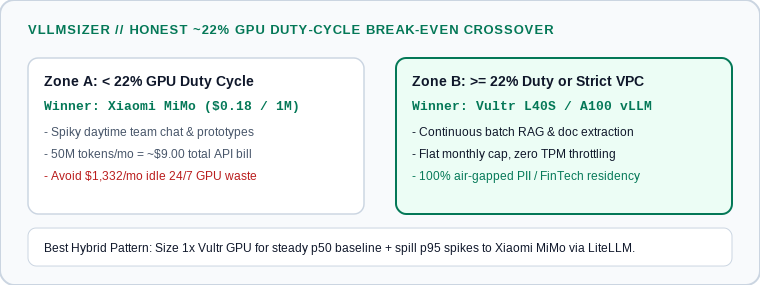
| Utilization Break-Even Verdict | Compare duty % vs ~22% threshold | Above ~22% duty: Dedicated Vultr vLLM GPU wins |
Core vLLMSizer FinOps Rule: Below ~22% sustained GPU duty cycle (without strict VPC residency rules), $0.18/1M Xiaomi MiMo serverless tokens beat 24/7 GPU leases every time. Above ~22% duty, AWQ + FP8 KV-cache vLLM on Vultr Cloud GPUs wins decisively.
— vLLMSizer Inference FinOps Desk (2026-11-12)
Three Production Laws of PagedAttention Memory & Inference FinOps
Why Concurrent Context Length Multiplies GPU Memory Faster Than Parameter Count
VRAM_GB = params_b * bytes_per_param * 1.12 + (concurrent_seqs * context_k * kv_mb_per_1k) / 1024Model weights + 12% CUDA/PyTorch activation overhead form only the static floor; every active streaming sequence reserves non-contiguous PagedAttention KV blocks proportional to layer count, GQA KV heads, and context window.
Inspect FinOps & memory proof (Theorem 01 · PagedAttention Weights + Linear KV-Cache Equation)
On Qwen 2.5 32B AWQ (0.55 B/param -> 19.7 GB static), serving 32 concurrent 16k-token requests with FP8 KV-cache (32 MB/1k) adds 16.0 GB KV memory (35.7 GB total)—fitting cleanly inside a single 48 GB L40S.
When Dedicated Vultr Cloud GPUs Beat $0.18/1M Xiaomi MiMo Serverless Tokens (And When They Lose)
break_even_duty_pct = dedicated_gpu_monthly_usd / (max_monthly_gpu_tokens_m * api_usd_per_1m)Leasing a 24/7 Cloud GPU below 10% duty cycle turns cheap open-weights models into $15+/1M token disasters. Below ~22% average utilization (without air-gap rules), Xiaomi MiMo ($0.18/1M) wins cleanly; above ~22% sustained batch/prod load, right-sized vLLM dominates.
Inspect FinOps & memory proof (Theorem 02 · The ~22% GPU Duty-Cycle Break-Even Law)
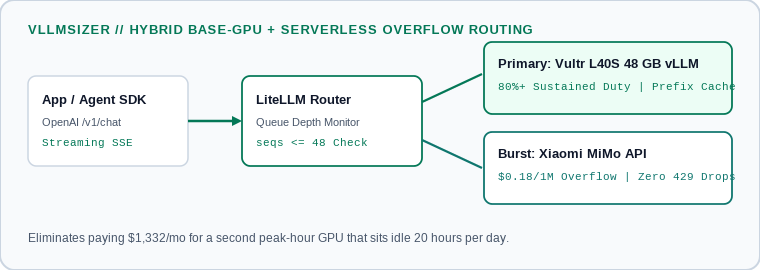
Combining dedicated Vultr L40S base capacity for steady traffic with LiteLLM overflow routing to Xiaomi MiMo captures 75%+ utilization without dropping burst requests.
Eliminating Cross-GPU NCCL All-Reduce Stalls via awq_marlin & FP8 KV-Cache
single_l40s_48gb (awq_marlin + fp8_kv) > 2x_24gb_pcie (--tensor-parallel-size 2)Splitting a 32B model across two PCIe GPUs without NVLink forces two NCCL all-reduce synchronizations per transformer layer (128 syncs per token). Quantizing weights to 4-bit awq_marlin and KV blocks to FP8 keeps the entire model on one 48 GB L40S.
Inspect FinOps & memory proof (Theorem 03 · Single-Card AWQ/FP8 Beats Dual-Card PCIe Tensor Parallelism)
vLLMSizer: Exact KV-Cache VRAM Math vs $5.40 Serverless Token APIs
FP8/AWQ Weights + PagedAttention KV Blocks + Concurrency Break-Even Utilization. Compare $1,200/mo Idle Dedicated GPUs vs Right-Sized Vultr GPU or Xiaomi MiMo API.
32x16k Concurrency Matrix & Three Production FinOps Case Studies
| Model & Precision | Weights (*1.12) | KV (32x16k) | Total VRAM | Target Cloud GPU | MiMo Break-Even |
|---|---|---|---|---|---|
| Llama 3.1 8B FP8 | 9.0 GB | 8.0 GB | 17.0 GB | Vultr L4 24 GB | 19% |
| Qwen 2.5 14B AWQ | 8.6 GB | 12.0 GB | 20.6 GB | Vultr L4 24 GB | 20% |
| Qwen 2.5 32B AWQ (FP8 KV) | 19.7 GB | 16.0 GB | 35.7 GB | Vultr L40S 48 GB | 22% |
| Llama 3.3 70B AWQ (FP8 KV) | 43.1 GB | 20.0 GB | 63.1 GB | Vultr A100 80 GB | 24% |
| Llama 3.3 70B FP16 (2x TP) | 156.8 GB | 40.0 GB | 196.8 GB | 4x L40S / 3x A100 | 31% |
Replacing an Idle $1,872/mo A100 80 GB Lease with Xiaomi MiMo API + Hourly Eval GPU
- Volume & VRAM
- 42M monthly tokens (business hours only, 6.4% average GPU utilization)
- Serving Stack
- Serverless Xiaomi MiMo ($0.18/1M) via Hostinger KVM4 LiteLLM proxy
- Prior Spend
- $1,872/mo (24/7 A100 mostly idle)
- Optimized Spend
- ~$32.55/mo ($7.56 tokens + $24.99 proxy)
Honest FinOps rule: never lease 24/7 GPUs below the ~22% utilization break-even unless compliance mandates zero external egress.
Serving 1.4 Billion Monthly Tokens on One Vultr L40S 48 GB Running Qwen 2.5 32B AWQ
- Volume & VRAM
- 39.7 GB allocated (19.7 GB weights + 20.0 GB FP8 KV for 40x16k streams)
- Serving Stack
- vllm serve --quantization awq_marlin --kv-cache-dtype fp8 --enable-prefix-caching
- Prior Spend
- $4,200/mo commercial frontier API bill
- Optimized Spend
- $1,332/mo flat Vultr L40S 48 GB
Automatic Prefix Caching achieved an 78% cache hit rate on shared 3,500-token extraction schemas, cutting TTFT to 34 ms.
Holding 82% GPU Utilization on Vultr A100 80 GB While Absorbing 3x Traffic Spikes
- Volume & VRAM
- 68.1 GB allocated (43.1 GB 70B AWQ + 25.0 GB FP8 KV for 40x16k streams)
- Serving Stack
- 1x Vultr A100 80 GB primary + Xiaomi MiMo overflow when active_seqs > 40
- Prior Spend
- $3,744/mo (2x A100 provisioned for peak hour)
- Optimized Spend
- ~$1,940/mo (1x A100 + $68 burst tokens)
Sizing GPUs for p50 sustained load instead of p99 peak hour eliminates an entire idle second A100.
vLLMSizer 2026-11-12 Cloud GPU & Token API Rate Ledger (Home FinOps Ledger)
| Vendor & Serving Tier | Compute & VRAM | Unit Rate | Monthly Baseline | Workload Fit | Provider Link |
|---|---|---|---|---|---|
| Xiaomi MiMo API — Serverless Token Endpoint ($0.18 / 1M) | Managed Cluster / Serverless | $0.18 / 1M tokens | $5.40/mo @ 30M tok | Home FinOps Ledger: Optimal below ~22% GPU duty cycle: spiky internal chat, dev/staging & burst overflow | Claim Xiaomi MiMo API (-10%) → |
| Vultr Cloud GPU — NVIDIA A16 / L4 24 GB GDDR6 | 6 vCPU / 32 GB RAM / 24 GB VRAM | $0.56/hr ($300 Credit) | $403.20/mo 24/7 | Home FinOps Ledger: Qwen 2.5 14B AWQ / Llama 3.1 8B FP8 at 24-48 concurrent 16k streams (>22% duty) | Claim $300 Vultr Cloud Credit → |
| Vultr Cloud GPU — NVIDIA L40S 48 GB Ada (FP8 Native) | 16 vCPU / 120 GB RAM / 48 GB VRAM | $1.85/hr | $1,332.00/mo 24/7 | Home FinOps Ledger: Qwen 2.5 32B AWQ + FP8 KV-cache (32-64 concurrent 16k seqs) & private VPC RAG | Deploy on Vultr Cloud → |
| Vultr Cloud GPU — NVIDIA A100 80 GB HBM2e | 12 vCPU / 120 GB RAM / 80 GB VRAM | $2.60/hr | $1,872.00/mo 24/7 | Home FinOps Ledger: Llama 3.3 70B AWQ/FP8 single-card serving without PCIe tensor-parallel latency | Deploy on Vultr Cloud → |
| Hostinger — KVM 4 NVMe (16 GB LiteLLM Gateway) | 4 EPYC vCPU / 16 GB VRAM | $9.99/mo intro | $24.99/mo renew | Home FinOps Ledger: LiteLLM OpenAI-compatible router load-balancing vLLM GPU nodes + MiMo fallback | Deploy on Hostinger KVM → |
vLLMSizer calculates monthly spend using 2026-11-12 listed retail tiers; currency conversion and optional add-ons will adjust your final invoice.
- Hostinger (Home FinOps Ledger) — KVM NVMe VPS tiers (KVM 1–KVM 8) public promotional & renewal rates
- Vultr (Home FinOps Ledger) — High Frequency Compute, Optimized Dedicated & Cloud GPU hourly/monthly rates
- UltaHost (Home FinOps Ledger) — Dedicated VDS NVMe RAID-10 and bare-metal resource tiers
- InterServer (Home FinOps Ledger) — KVM slice pricing, Storage VPS (1TB–20TB), and Price-Lock renewal guarantee
- ChemiCloud (Home FinOps Ledger) — LiteSpeed NVMe shared/managed cloud tiers and renewal schedule
Specialized KV-Cache Dossiers & Throughput FinOps Ledgers
KV-Cache Engineering Dossiers (5 Guides)
GQA vs MHA math, AWQ Marlin + FP8 KV tuning, --max-model-len prefix caching, and PCIe vs single-GPU benchmarks.
Explore KV-Cache Dossiers HubThroughput & Break-Even Ledgers (4 Guides)
Proof of the 22% duty rule, LiteLLM + MiMo burst routing, chunked-prefill TTFT SLAs, and air-gapped VPC economics.
Explore Throughput Ledgers HubvLLMSizer Engineering & Token FinOps FAQ
How does vLLMSizer compute exact GPU VRAM for PagedAttention KV-cache?
vLLMSizer evaluates VRAM_GB = params_b * bytes_per_param * 1.12 + (concurrent_seqs * context_k * kv_mb_per_1k) / 1024. The 1.12 multiplier accounts for PyTorch CUDA kernels and CUDA graph captures, while the second term computes active PagedAttention KV blocks across all concurrent sequences.
Why does the ~22% GPU duty-cycle break-even matter before renting a dedicated Cloud GPU?
Because a 24/7 Cloud GPU bills every hour whether requests arrive or not. Against ultra-affordable serverless endpoints like Xiaomi MiMo ($0.18/1M tokens via /go/xiaomi-mimo), a dedicated GPU only becomes cheaper once sustained token volume keeps the card busy above roughly ~22% average duty cycle—or immediately if compliance forbids external API calls.
How much VRAM does --kv-cache-dtype fp8 save on Vultr L40S 48 GB instances?
Switching KV-cache storage from FP16 (2 bytes) to FP8 E4M3 (1 byte) on Ada Lovelace L40S GPUs cuts KV memory strictly in half—shrinking 32 concurrent 16k streams on Qwen 2.5 32B from 32 GB KV down to 16 GB KV so both weights and cache fit comfortably inside 48 GB.
Can we combine Vultr Cloud GPUs and Xiaomi MiMo API in one production stack?
Yes—that is our #1 FinOps pattern. Size a single Vultr L40S 48 GB (/go/vultr, /go/vultr-promo) for your baseline steady traffic so it runs at 75%+ utilization, and configure LiteLLM to spill sudden peak bursts over to Xiaomi MiMo (/go/xiaomi-mimo) with zero dropped requests.
vLLMSizer FinOps Verdict: vLLM PagedAttention KV-Cache VRAM & Token API Break-Even Ledger
Always verify both halves of the inference equation: size weights + FP8 KV-cache onto a single L40S/A100 GPU to avoid PCIe sync stalls, and check that sustained traffic clears ~22% duty cycle (or route spiky workloads directly to Xiaomi MiMo).
vLLMSizer maintains this vLLM PagedAttention KV-Cache VRAM & Token API Break-Even Ledger specification against 2026-11-12 public Cloud GPU and token API sheets; confirm live checkout billing prior to provisioning.