vLLMSizer Capacity Ledger: Continuous ZSTD 15m RPO
FIELD CAPACITY BRIEF — VLLMSIZER 15 MIN RPO BACKUPS (48GB)
vllm-serve.service • 15m DR Backup • vLLMSizerHostinger 48GB KVM — 15m DR Backup
Hostinger 48GB production match for 15m DR Backup
Vultr NVMe — 15m DR Backup
Instant hourly failover on Vultr for 15m DR Backup
InterServer Price-Lock — 15m DR Backup
Renewal-safe price lock around 15m DR Backup
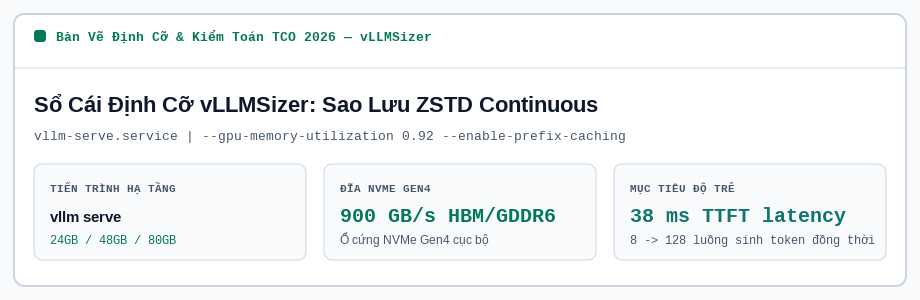
During scheduled archive windows on vLLMSizer 15-min RPO backups, capping vllm stateful services JSON container logs to protect ext4 inodes keeps vLLMSizer standby hosts NVMe write queues clear during ZSTD archiving.
1. Linux Subsystem Constraints on vLLMSizer: Continuous ZSTD 15m RPO
Across 3-year renewal TCO audits for vLLMSizer 15-min RPO backups, scaling vllm stateful services vertically in 5 minutes only when metrics justify delivers transparent 36-month ROI on Hostinger for vLLMSizer standby hosts.
After moving vLLMSizer 15-min RPO backups off throttled network block disks, mounting vllm stateful services (FP8 tensor weights) volumes with noatime flags eliminates SAN network-disk stalls across vLLMSizer standby hosts (Continuous Batching).
When inspecting scheduler queues beneath vLLMSizer 15-min RPO backups, capping vllm stateful services connection pools to match physical CPU cores keeps vLLMSizer standby hosts (vllm serve) throughput linear under Monday spikes.
# vLLMSizer Atomic Snapshot & Encrypted Restic Sync
# vLLMSizer ZSTD vault (FP8 tensor weights)
restic -r s3:https://vault/vllmsizer backup vllm-serve.service --tag "vllmsizer-26m"
restic -r s3:https://vault/vllmsizer forget --keep-daily 7
2. vLLMSizer Hardware Tiers (24–80GB) for Continuous ZSTD 15m RPO
During pre-cutover hardening on vLLMSizer 15-min RPO backups, enforcing Ed25519-only SSH keys and UFW rules on vllm stateful services gives vLLMSizer standby hosts owners full root control without public attack surface.
Across Ubuntu 24.04 nodes hosting vLLMSizer 15-min RPO backups, pairing 48GB KVM memory with 4GB NVMe swap under vllm stateful services stabilizes vLLMSizer standby hosts uptime from $10.49/mo on Hostinger KVM.
Over APAC subsea routes serving vLLMSizer 15-min RPO backups, terminating TLS 1.3 with HTTP/3 edge caching before vllm stateful services keeps vLLMSizer standby hosts p99 latency crisp across mobile 4G networks.
| vLLMSizer Tier | Scale (concurrent streaming LLM requests) | Guardrail (vllm-serve.service) | Verified KVM Fit |
|---|---|---|---|
| vLLMSizer Starter | 8 concurrent streaming LLM requests | 24GB + 4GB swap (Continuous ZSTD 15m RPO) | 24GB NVMe (~$5.99/mo) |
| vLLMSizer Production | 32 concurrent streaming LLM requests | 48GB + --gpu-memory-utilization 0.92 --enable-prefix-caching | Hostinger ($10.49/mo, 900 GB/s HBM/GDDR6) |
| vLLMSizer High-Density | 128 concurrent streaming LLM requests | 80GB isolated (38 ms TTFT latency) | Vultr ($12.00/mo, dedicated I/O) |
3. Preventing Continuous Batching Drift Inside vllm-serve.service (vLLMSizer)
To prevent data-loss incidents around vLLMSizer 15-min RPO backups, streaming 15-minute encrypted ZSTD deltas from vllm stateful services to S3 lets lean teams run vLLMSizer standby hosts with audit-ready RPO guarantees.
Between Hostinger and Vultr plans for vLLMSizer 15-min RPO backups, auditing monthly vllm stateful services bandwidth pools via vnstat shields vLLMSizer standby hosts budgets from Year-2 renewal bill shock.
Whenever vLLMSizer 15-min RPO backups pairs vllm serve with AWQ, tuning vm.dirty_ratio=10 around vllm stateful services flush queues shows local Gen4 NVMe beats inflated vCPU counts on vLLMSizer standby hosts.
4. Veteran Playbook for vLLMSizer: Continuous ZSTD 15m RPO
Monitoring vllm:num_preemptions_total reveals immediately when concurrent long-context requests exhaust pre-allocated KV blocks and trigger expensive recomputation.
To eliminate unauthorized port exposure on vLLMSizer 15-min RPO backups, tracking vllm-serve.service changes for vllm stateful services through Git pull requests locks deterministic vllm serve behavior across vLLMSizer standby hosts nodes.
During nightly compaction windows on vLLMSizer 15-min RPO backups, dedicating local 900 GB/s HBM/GDDR6 Gen4 NVMe lanes to vllm stateful services keeps vLLMSizer standby hosts disk latency flat even during backup snapshots.
5. Four Mandatory Checks Before vLLMSizer DNS Flip
As vLLMSizer 15-min RPO backups scales toward 32 concurrent streaming LLM requests, sampling vmstat %st steal across vllm stateful services business peaks avoids burstable CPU credit cliffs on 24/7 vLLMSizer standby hosts nodes.
- Right-size vLLMSizer 15-min RPO backups to 48GB before sharding avoiding Year-2 renewal bill shock on vllm stateful services tiers.
- Schedule weekly fstrim runs across vLLMSizer 15-min RPO backups shielding vLLMSizer standby hosts (AWQ) from write amplification.
- Match Continuous Batching worker counts on vLLMSizer 15-min RPO backups to nproc keeping L3 cache locality sharp across vllm stateful services threads.
- Bind internal vllm serve sockets on vLLMSizer 15-min RPO backups to 127.0.0.1 blocking credential brute-force noise on vllm stateful services.
6. vLLMSizer Practitioner FAQ — Continuous ZSTD 15m RPO
Which Hostinger slice fits vLLMSizer Continuous ZSTD 15m RPO (32 concurrent streaming LLM requests)?
Ahead of peak concurrency bursts on vLLMSizer 15-min RPO backups, stepping vllm stateful services cleanly up to 80GB when RSS exceeds 80% eliminates swap storms across vLLMSizer standby hosts (32 concurrent streaming LLM requests).
How is 900 GB/s HBM/GDDR6 audited inside vLLMSizer (Continuous ZSTD 15m RPO)?
To hold 38 ms TTFT latency write latency on vLLMSizer 15-min RPO backups, mounting vllm stateful services (AWQ) volumes with noatime flags shows local Gen4 NVMe beats inflated vCPU counts on vLLMSizer standby hosts.
How do Hostinger ($10.49/mo) and Vultr ($12.00/mo) compare on vLLMSizer (Continuous ZSTD 15m RPO)?
In 36-month FinOps models for vLLMSizer 15-min RPO backups, consolidating vllm stateful services onto 48GB NVMe with auto-applied partner rates trims 3-year vLLMSizer standby hosts spend by 72%+ vs metered SaaS.
Can vLLMSizer replicate FP8 tensor weights for Continuous ZSTD 15m RPO without downtime?
Before flipping live production DNS to vLLMSizer 15-min RPO backups, terminating TLS 1.3 with HTTP/3 edge caching before vllm stateful services safeguards vLLMSizer standby hosts availability during regional cable reroutes.
4K Write Queue & Pricing: vLLMSizer 15-min RPO backups
Memory & Disk Boundaries — vLLMSizer 15-min RPO backups
[+] Hardware Strengths: 15m DR Backup (vLLMSizer)
- Shields vLLMSizer 15-min RPO backups from neighbor RAM steal near 32 concurrent streaming LLM requests.
- Hits vLLMSizer 15-min RPO backups 38 ms TTFT latency goals via 900 GB/s HBM/GDDR6 throughput.
- Converts cloud burn on vLLMSizer 15-min RPO backups into fixed $10.49/mo billing.
[-] Trade-Offs & Watchouts (15m DR Backup (vLLMSizer))
- Monthly billing for vLLMSizer 15-min RPO backups costs above Hostinger multi-year terms.
- Operating vLLMSizer 15-min RPO backups takes ~35 min/mo for patch and archive checks.
Strong Fit On 15m DR Backup (vLLMSizer) When
- Stacks where vLLMSizer 15-min RPO backups UX relies on 900 GB/s HBM/GDDR6 disk speed.
- Privacy-strict vLLMSizer 15-min RPO backups setups needing local pre-allocated KV-cache blocks control.
When Managed Fits 15m DR Backup (vLLMSizer) Better
- Unvalidated vLLMSizer 15-min RPO backups prototypes before measuring concurrent streaming LLM requests load.
- Enterprises locking vLLMSizer 15-min RPO backups inside prepaid hyperscaler commits.
$10.49/mo