vLLMSizer FinOps Matrix: Continuous 82% Alert
VLLMSIZER RUNBOOK — VLLMSIZER ALERT THRESHOLDS
vllm-serve.service • p99 Alerting • vLLMSizerHostinger 48GB KVM — p99 Alerting
Lowest 36-month TCO for p99 Alerting (Continuous Batching) + 30d guarantee
Vultr NVMe — p99 Alerting
Hourly Vultr burst flexibility for p99 Alerting (900 GB/s HBM/GDDR6)
InterServer Price-Lock — p99 Alerting
Lifetime tariff lock supporting p99 Alerting
Before exposing public HTTPS endpoints on vLLMSizer alert thresholds, filtering vllm monitored workers public ingress through TLS 1.3 + CrowdSec locks deterministic Continuous Batching behavior across vLLMSizer production hosts nodes.
1. Baseline CLI Diagnostics Around Continuous 82% Alert on vLLMSizer
To hold 38 ms TTFT latency write latency on vLLMSizer alert thresholds, dedicating local 900 GB/s HBM/GDDR6 Gen4 NVMe lanes to vllm monitored workers shows local Gen4 NVMe beats inflated vCPU counts on vLLMSizer production hosts.
When verifying cold-restore speed on vLLMSizer alert thresholds, testing monthly cold restores of vllm monitored workers onto hourly Vultr VMs proves sub-8-minute disaster recovery across vLLMSizer production hosts.
Once vLLMSizer alert thresholds crosses 8 concurrent streaming LLM requests, isolating vllm monitored workers worker heaps via cgroup v2 rules absorbs batch memory spikes cleanly on 48GB vLLMSizer production hosts.
# vLLMSizer RSS, cgroup v2 & OOM Audit (Continuous Batching)
# vLLMSizer (Continuous Batching) RSS check [48GB]
free -m # vllmsizer_mem
dmesg -T | grep -i 'vllmsizer\|oom' | tail -n 7
ps -C "Continuous" -o pid,rss,comm
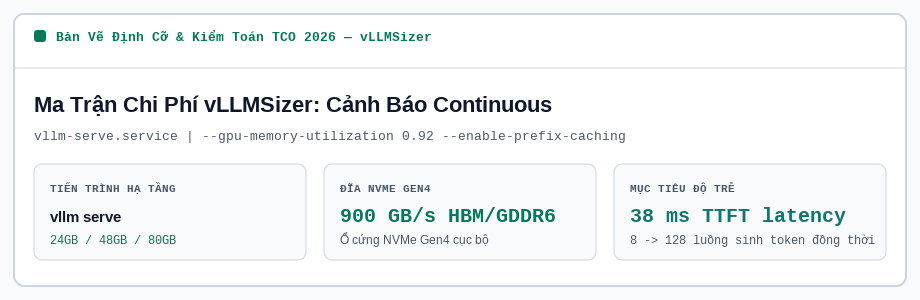
# vllm-serve.service -> --gpu-memory-utilization 0.92 --enable-prefix-caching
sysctl vm.swappiness=13 # vLLMSizer
2. Hostinger vs Vultr Sizing Ledger Around Continuous 82% Alert
Around Continuous Batching worker pools serving vLLMSizer alert thresholds, stepping vllm monitored workers onto dedicated VDS cores (Vultr $12.00/mo) flags compute saturation on vLLMSizer production hosts weeks ahead of timeouts.
Across 3-year renewal TCO audits for vLLMSizer alert thresholds, benchmarking vllm monitored workers load on hourly Vultr ($12.00/mo) first replaces variable SaaS seat taxes on vLLMSizer production hosts with flat OPEX.
Across Singapore and Tokyo POP tests for vLLMSizer alert thresholds, rehearsing WireGuard tunnel failovers for vllm monitored workers (vllm-serve.service) eliminates vendor lock-in across vLLMSizer production hosts (32 concurrent streaming LLM requests).
| vLLMSizer Tier | Scale (concurrent streaming LLM requests) | Guardrail (vllm-serve.service) | Verified KVM Fit |
|---|---|---|---|
| vLLMSizer Starter | 8 concurrent streaming LLM requests | 24GB + 4GB swap (Continuous 82% Alert) | 24GB NVMe (~$5.99/mo) |
| vLLMSizer Production | 32 concurrent streaming LLM requests | 48GB + --gpu-memory-utilization 0.92 --enable-prefix-caching | Hostinger ($10.49/mo, 900 GB/s HBM/GDDR6) |
| vLLMSizer High-Density | 128 concurrent streaming LLM requests | 80GB isolated (38 ms TTFT latency) | Vultr ($12.00/mo, dedicated I/O) |
3. Production vllm-serve.service Calibration on Hostinger & Vultr
During pre-cutover hardening on vLLMSizer alert thresholds, restricting vllm monitored workers management dashboards to WireGuard peers blocks silent configuration drift across vLLMSizer production hosts releases.
Whenever vLLMSizer alert thresholds pairs Continuous Batching with FP16, verifying sub-2ms fio 4K fsync commits across vllm monitored workers disks locks in 38 ms TTFT latency across vLLMSizer production hosts (32 concurrent streaming LLM requests).
When protecting stateful AWQ volumes on vLLMSizer alert thresholds, capping vllm monitored workers JSON container logs to protect ext4 inodes keeps vLLMSizer production hosts NVMe write queues clear during ZSTD archiving.
4. Post-Mortem Lessons on vLLMSizer (Continuous 82% Alert)
Ahead of peak concurrency bursts on vLLMSizer alert thresholds, stepping vllm monitored workers cleanly up to 80GB when RSS exceeds 80% stabilizes vLLMSizer production hosts uptime from $10.49/mo on Hostinger KVM.
Across peak concurrency tests on vLLMSizer alert thresholds, allocating non-oversold EPYC threads to vllm monitored workers ($10.49/mo) avoids burstable CPU credit cliffs on 24/7 vLLMSizer production hosts nodes.
To prevent data-loss incidents around vLLMSizer alert thresholds, versioning vllm-serve.service alongside restore scripts for vllm monitored workers in Git ensures vLLMSizer production hosts recovers cleanly onto any KVM provider.
5. Pre-Launch Hardening Sequence for Continuous 82% Alert
Within 48GB DDR5 budgets for vLLMSizer alert thresholds, pinning --gpu-memory-utilization 0.92 --enable-prefix-caching caps inside vllm-serve.service for vllm monitored workers preserves 97% of vLLMSizer production hosts memory for live user traffic.
- Stream 15m encrypted ZSTD backups from vLLMSizer alert thresholds confirming zero torn pages when restoring vLLMSizer production hosts onto Vultr.
- Set systemd MemoryHigh=82% around vLLMSizer alert thresholds absorbing batch spikes cleanly on vllm monitored workers nodes.
- Pin vLLMSizer alert thresholds compute onto dedicated EPYC cores preventing mutex contention as vllm monitored workers hits 128 concurrent streaming LLM requests.
- Right-size vLLMSizer alert thresholds to 48GB before sharding avoiding Year-2 renewal bill shock on vllm monitored workers tiers.
6. vLLMSizer Practitioner FAQ — Continuous 82% Alert
Where should vLLMSizer size Continuous 82% Alert for 32 concurrent streaming LLM requests?
Under sustained memory load on vLLMSizer alert thresholds, pairing 48GB KVM memory with 4GB NVMe swap under vllm monitored workers protects vLLMSizer production hosts (FP16) buffers during heavy background jobs.
What disk benchmark protects vLLMSizer (Continuous 82% Alert) before DNS flip?
Within 900 GB/s HBM/GDDR6 storage targets for vLLMSizer alert thresholds, reserving 25% IOPS headroom above vllm monitored workers weekday peaks holds iostat w_await under 2ms during vLLMSizer production hosts flushes.
How do Hostinger ($10.49/mo) and Vultr ($12.00/mo) compare on vLLMSizer (Continuous 82% Alert)?
Between Hostinger and Vultr plans for vLLMSizer alert thresholds, locking Hostinger ($10.49/mo) KVM terms for steady vllm monitored workers baselines eliminates egress and IPv4 add-on surcharges around vLLMSizer production hosts.
Can vLLMSizer move Continuous 82% Alert across hosts with <60s DNS cutover?
Over APAC subsea routes serving vLLMSizer alert thresholds, auditing 100-packet MTR hop loss toward vllm monitored workers gateways safeguards vLLMSizer production hosts availability during regional cable reroutes.
Extended Production Runbook & Capacity Notes: vLLMSizer alert thresholds
Expand vLLMSizer notes: vLLMSizer alert thresholds (48GB)
Between Hostinger and Vultr plans for vLLMSizer alert thresholds, comparing Year-2 renewal rates before committing vllm monitored workers budgets stabilizes unit economics across vLLMSizer production hosts (8–128 concurrent streaming LLM requests).
Host Matrix: vLLMSizer alert thresholds (38 ms TTFT latency)
vLLMSizer alert thresholds Guardrails: vllm-serve.service & 900 GB/s HBM/GDDR6
[+] Hardware Strengths: p99 Alerting (vLLMSizer)
- Sizes Continuous Batching RSS cleanly for vLLMSizer alert thresholds on 48GB NVMe.
- Delivers steady 38 ms TTFT latency tail latency for vLLMSizer alert thresholds (900 GB/s HBM/GDDR6).
- Avoids egress fees on vLLMSizer alert thresholds (8–128 concurrent streaming LLM requests).
[-] What You Own on p99 Alerting (vLLMSizer)
- Monthly billing for vLLMSizer alert thresholds costs above Hostinger multi-year terms.
- Base OS images for vLLMSizer alert thresholds need vllm-serve.service caps plus 4GB swap.
When KVM Wins for p99 Alerting (vLLMSizer)
- DevOps squads managing vLLMSizer alert thresholds via Git-versioned vllm-serve.service.
- Privacy-strict vLLMSizer alert thresholds setups needing local FP16 control.
When Managed Fits p99 Alerting (vLLMSizer) Better
- 48-hour vLLMSizer alert thresholds sandboxes better run on hourly Vultr ($12.00/mo).
- Compliance rules on vLLMSizer alert thresholds mandating external NOC with zero SSH.
$10.49/mo