Hybrid Base + Burst LLM Routing: Vultr vLLM + Xiaomi MiMo API
3 SECOND INFRA PICK: VLLMSIZER HYBRID BASE + BURST LLM
vllm-serve.service • Litellm Routing • vLLMSizerHostinger 48GB KVM — Litellm Routing
Matched 48GB tier for Litellm Routing (900 GB/s HBM/GDDR6)
Vultr NVMe — Litellm Routing
Fast APAC route on Litellm Routing (vllm-serve.service ready)
InterServer Price-Lock — Litellm Routing
Zero renewal hike on InterServer for Litellm Routing ($6.00/mo)
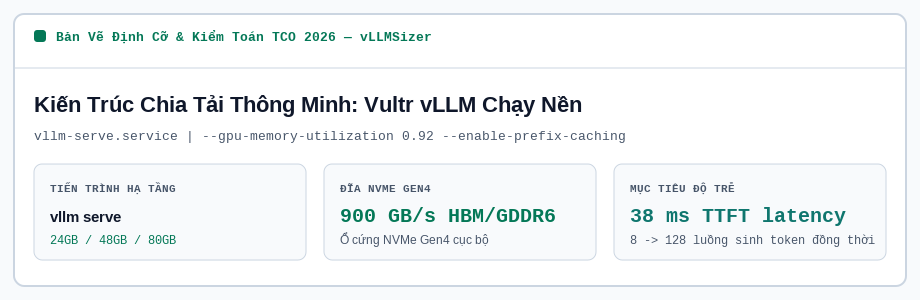
Eliminate over-provisioned peak-hour GPUs by routing p95 queue overflows automatically to low-cost serverless endpoints.
Controlling inference invariant for Hybrid Base + Burst Routing (vLLM Primary + Xiaomi MiMo Fallback): 80%+ base GPU duty + zero-queue-drop serverless overflow — preventing KV-cache block exhaustion and latency spikes.
Production CLI & Sizing Rule: Hybrid Base + Burst Routing (vLLM Primary + Xiaomi MiMo Fallback)
# litellm_config.yaml — Primary Self-Hosted vLLM + Serverless Burst Fallback
model_list:
  - model_name: prod-assistant
    litellm_params:
      model: openai/Qwen2.5-32B-Instruct-AWQ
      api_base: http://10.0.0.5:8000/v1
      max_parallel_requests: 48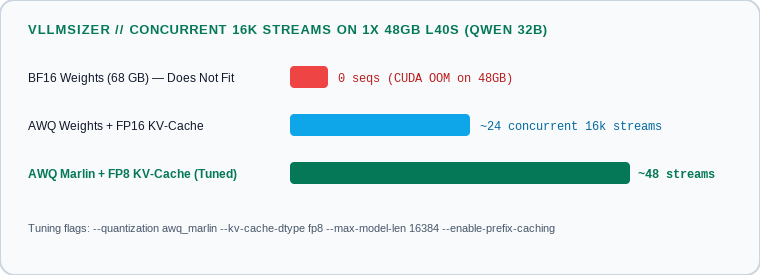
Hardware & Break-Even Reference for Hybrid Base + Burst Routing (vLLM Primary + Xiaomi MiMo Fallback)
| Model Tier | VRAM (32x16k FP8 KV) | Below ~22% Duty | Above ~22% Duty / VPC |
|---|---|---|---|
| 8B - 14B AWQ/FP8 | 17.0 - 20.6 GB | Xiaomi MiMo ($0.18/1M) | Vultr L4 24 GB ($403/mo) |
| 32B AWQ + FP8 KV | 35.7 GB | Xiaomi MiMo ($0.18/1M) | Vultr L40S 48 GB ($1,332/mo) |
| 70B AWQ + FP8 KV | 63.1 GB | Xiaomi MiMo ($0.18/1M) | Vultr A100 80 GB ($1,872/mo) |
vLLMSizer FinOps Verdict: Hybrid Base + Burst Routing (vLLM Primary + Xiaomi MiMo Fallback)
Validate Hybrid Base + Burst Routing (vLLM Primary + Xiaomi MiMo Fallback) parameters inside the vLLMSizer homepage calculator to generate your exact vllm serve command.
VLLMSizer maintains this Hybrid Base + Burst Routing (vLLM Primary + Xiaomi MiMo Fallback) specification against 2026-11-12 public Cloud GPU and token API sheets; confirm live checkout billing prior to provisioning.
Zero-Trust Loopback & UFW Policy (Hybrid Base + Burst LLM Routing)
Around Continuous Batching worker pools serving Hybrid Base + Burst LLM Routing, sizing Litellm Hybrid processes IPC on single-node memory before clustering holds hypervisor %st steal below 1.2% on Mimo Burst KVM nodes hosts.
Whenever Hybrid Base + Burst LLM Routing pairs vllm serve with AWQ, running weekly fstrim maintenance on Litellm Hybrid processes Gen4 media sustains 900 GB/s HBM/GDDR6 throughput under peak Mimo Burst KVM nodes writes.
Instead of over-provisioning cloud instances for Hybrid Base + Burst LLM Routing, benchmarking Litellm Hybrid processes load on hourly Vultr ($12.00/mo) first delivers transparent 36-month ROI on Hostinger for Mimo Burst KVM nodes.
# Disk fill, inode & transfer check (litellm-hybrid-vllm-mimo-burst-routing)
df -hT / && df -i /
du -sh /var/lib/* 2>/dev/null | sort -hr | head -n 6| Hybrid Base + Burst LLM Stage | Load (concurrent streaming LLM requests) | Cap (vllm-serve.service) | vLLMSizer Host Fit |
|---|---|---|---|
| Baseline — Hybrid Base + Burst LLM | 8 concurrent streaming LLM requests | 24GB + 4GB swap | 24GB NVMe (~$5.99/mo) |
| Production — Hybrid Base + Burst LLM | 32 concurrent streaming LLM requests | 48GB + --gpu-memory-utilization 0.92 --enable-prefix-caching | Hostinger ($10.49/mo, 900 GB/s HBM/GDDR6) |
| Peak — Hybrid Base + Burst LLM | 128 concurrent streaming LLM requests | 80GB (38 ms TTFT latency) | Vultr ($12.00/mo, isolated Continuous Batching) |
Before signing off production readiness for Hybrid Base + Burst LLM Routing,
validating Litellm Hybrid processes (pre-allocated KV-cache blocks) checksums before rotating snapshots protects Mimo Burst KVM nodes (pre-allocated KV-cache blocks) integrity through unexpected reboots.
When tuning Linux ingress queues around Hybrid Base + Burst LLM Routing, terminating TLS 1.3 with HTTP/3 edge caching before Litellm Hybrid processes eliminates vendor lock-in across Mimo Burst KVM nodes (32 concurrent streaming LLM requests).
Extended vLLMSizer notes: Hybrid Base + Burst LLM
Within 900 GB/s HBM/GDDR6 storage targets for Hybrid Base + Burst LLM Routing, tuning vm.dirty_ratio=10 around Litellm Hybrid processes flush queues holds iostat w_await under 2ms during Mimo Burst KVM nodes flushes.
Between Hostinger and Vultr plans for Hybrid Base + Burst LLM Routing, scaling Litellm Hybrid processes vertically in 5 minutes only when metrics justify eliminates egress and IPv4 add-on surcharges around Mimo Burst KVM nodes.
Across disaster-recovery drills for Hybrid Base + Burst LLM Routing, staggering Litellm Hybrid processes backup crons off peak concurrent streaming LLM requests hours proves sub-8-minute disaster recovery across Mimo Burst KVM nodes.
Across Singapore and Tokyo POP tests for Hybrid Base + Burst LLM Routing, rehearsing WireGuard tunnel failovers for Litellm Hybrid processes (vllm-serve.service) safeguards Mimo Burst KVM nodes availability during regional cable reroutes.
Ahead of peak concurrency bursts on Hybrid Base + Burst LLM Routing, preserving kernel pagecache buffers around hot Litellm Hybrid processes tables stabilizes Mimo Burst KVM nodes uptime from $10.49/mo on Hostinger KVM.
To eliminate unauthorized port exposure on Hybrid Base + Burst LLM Routing, restricting Litellm Hybrid processes management dashboards to WireGuard peers hides Mimo Burst KVM nodes daemon sockets from automated port scanners.
Rollout Checks & FinOps FAQ — Hybrid Base + Burst LLM Routing
- Bind internal Continuous Batching sockets on Hybrid Base + Burst LLM Routing to 127.0.0.1 blocking credential brute-force noise on Litellm Hybrid processes.
- Sample vmstat %st steal during Hybrid Base + Burst LLM Routing peaks keeping L3 cache locality sharp across Litellm Hybrid processes threads.
- Confirm sub-2ms fio 4K fsync on Hybrid Base + Burst LLM Routing holding w_await <2ms across Litellm Hybrid processes commits.
- Right-size Hybrid Base + Burst LLM Routing to 48GB before sharding cutting 3-year Mimo Burst KVM nodes spend by 70%+ vs metered SaaS.
How do vLLMSizer admins spot memory pressure on Hybrid Base + Burst LLM Routing early?
Under sustained memory load on Hybrid Base + Burst LLM Routing, keeping 30% RAM headroom above Litellm Hybrid processes (vllm serve) RSS eliminates swap storms across Mimo Burst KVM nodes (32 concurrent streaming LLM requests).
Where should --gpu-memory-utilization 0.92 --enable-prefix-caching live for deterministic Hybrid Base + Burst LLM Routing boots?
Under strict configuration governance for Hybrid Base + Burst LLM Routing, binding internal Litellm Hybrid processes (Continuous Batching) sockets strictly to 127.0.0.1 turns Mimo Burst KVM nodes security upkeep into a 35-min/mo routine.
How do APAC routes compare between Hostinger and Vultr for Hybrid Base + Burst LLM Routing?
In 36-month FinOps models for Hybrid Base + Burst LLM Routing, auditing monthly Litellm Hybrid processes bandwidth pools via vnstat aligns Mimo Burst KVM nodes infrastructure spend cleanly with actual load.
IOPS Headroom vs Cost (vLLMSizer Hybrid Base + Burst LLM)
Kernel & cgroup Flow — vLLMSizer Hybrid Base + Burst LLM
[+] Verified Upside on Hybrid Base + Burst (vLLMSizer)
- Gives vLLMSizer Hybrid Base + Burst LLM (Continuous Batching) 30% RAM headroom at 32 concurrent streaming LLM requests.
- Holds shallow NVMe queues on vLLMSizer Hybrid Base + Burst LLM during snapshot runs.
- Unlocks root SSH on vLLMSizer Hybrid Base + Burst LLM to set --gpu-memory-utilization 0.92 --enable-prefix-caching in vllm-serve.service.
[-] Trade-Offs & Watchouts (Hybrid Base + Burst (vLLMSizer))
- 30-day cycles on vLLMSizer Hybrid Base + Burst LLM miss the deepest Hostinger cart rebate.
- Base OS images for vLLMSizer Hybrid Base + Burst LLM need vllm-serve.service caps plus 4GB swap.
Choose 48GB for Hybrid Base + Burst (vLLMSizer) If
- Builders wanting Ubuntu 24.04 + WireGuard around vLLMSizer Hybrid Base + Burst LLM (Continuous Batching).
- Deployments hitting 38 ms TTFT latency on vLLMSizer Hybrid Base + Burst LLM via TCP BBR + NVMe.
Better Served Elsewhere On Hybrid Base + Burst (vLLMSizer) If
- 2-hour vLLMSizer Hybrid Base + Burst LLM failover drills torn down right after testing.
- Compliance rules on vLLMSizer Hybrid Base + Burst LLM mandating external NOC with zero SSH.
$10.49/mo