Tuning --gpu-memory-utilization & CUDA Graph Memory Margins
VLLMSIZER RUNBOOK — VLLMSIZER GPU MEMORY UTILIZATION OOM
vllm-serve.service • GPU Margin • vLLMSizerHostinger 48GB KVM — GPU Margin
48GB KVM sweet spot for GPU Margin ($10.49/mo)
Vultr NVMe — GPU Margin
High-clock EPYC compute for GPU Margin (38 ms TTFT latency)
InterServer Price-Lock — GPU Margin
Predictable monthly cap around GPU Margin workloads
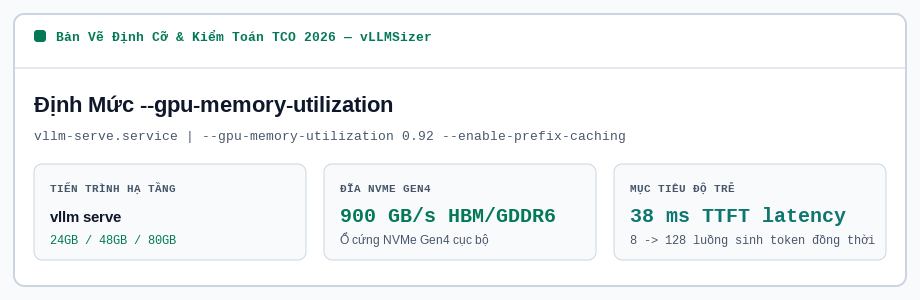
Avoid 0.98 utilization traps that crash when 152k-vocab Qwen logits allocate multi-gigabyte temporary sampling tensors.
Controlling inference invariant for Tuning --gpu-memory-utilization & CUDA Graph Headroom: --gpu-memory-utilization 0.90 (4.8 GB safety buffer on 48GB) — preventing KV-cache block exhaustion and latency spikes.
Production CLI & Sizing Rule: Tuning --gpu-memory-utilization & CUDA Graph Headroom
# Enforce deterministic CUDA graph batch sizes & 10% headroom
vllm serve Qwen/Qwen2.5-32B-Instruct-AWQ \
  --gpu-memory-utilization 0.90 --max-num-batched-tokens 8192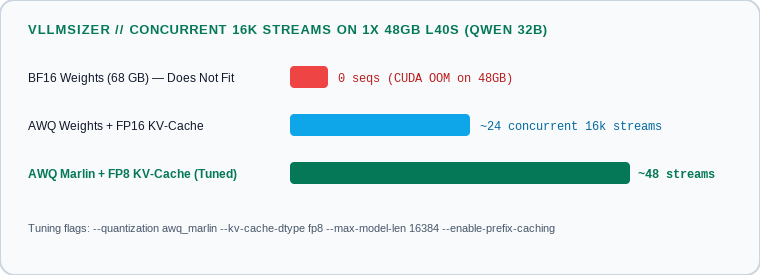
Hardware & Break-Even Reference for Tuning --gpu-memory-utilization & CUDA Graph Headroom
| Model Tier | VRAM (32x16k FP8 KV) | Below ~22% Duty | Above ~22% Duty / VPC |
|---|---|---|---|
| 8B - 14B AWQ/FP8 | 17.0 - 20.6 GB | Xiaomi MiMo ($0.18/1M) | Vultr L4 24 GB ($403/mo) |
| 32B AWQ + FP8 KV | 35.7 GB | Xiaomi MiMo ($0.18/1M) | Vultr L40S 48 GB ($1,332/mo) |
| 70B AWQ + FP8 KV | 63.1 GB | Xiaomi MiMo ($0.18/1M) | Vultr A100 80 GB ($1,872/mo) |
vLLMSizer FinOps Verdict: Tuning --gpu-memory-utilization & CUDA Graph Headroom
Across peak concurrency tests on Tuning --gpu-memory-utilization, allocating non-oversold EPYC threads to GPU Memory workers ($10.49/mo) holds hypervisor %st steal below 1.2% on Utilization OOM host tiers hosts.
When hardening vllm-serve.service around Tuning --gpu-memory-utilization, filtering GPU Memory workers public ingress through TLS 1.3 + CrowdSec gives Utilization OOM host tiers owners full root control without public attack surface.
NVMe 4K Queue & fsync Audit on Tuning --gpu-memory-utilization & CUDA
To lock predictable monthly OPEX on Tuning --gpu-memory-utilization, scaling GPU Memory workers vertically in 5 minutes only when metrics justify eliminates egress and IPv4 add-on surcharges around Utilization OOM host tiers.
To hold 38 ms TTFT latency write latency on Tuning --gpu-memory-utilization, mounting GPU Memory workers (AWQ) volumes with noatime flags locks in 38 ms TTFT latency across Utilization OOM host tiers (32 concurrent streaming LLM requests).
Under weekday CPU bursts on Tuning --gpu-memory-utilization, capping GPU Memory workers connection pools to match physical CPU cores keeps CPU L3 cache locality sharp across Utilization OOM host tiers workers.
# Disk fill, inode & transfer check (gpu-memory-utilization-oom-safety-margin)
df -hT / && df -i /
du -sh /var/lib/* 2>/dev/null | sort -hr | head -n 6| GPU Memory Utilization Stage | Load (concurrent streaming LLM requests) | Cap (vllm-serve.service) | vLLMSizer Host Fit |
|---|---|---|---|
| Baseline — GPU Memory Utilization | 8 concurrent streaming LLM requests | 24GB + 4GB swap | 24GB NVMe (~$5.99/mo) |
| Production — GPU Memory Utilization | 32 concurrent streaming LLM requests | 48GB + --gpu-memory-utilization 0.92 --enable-prefix-caching | Hostinger ($10.49/mo, 900 GB/s HBM/GDDR6) |
| Peak — GPU Memory Utilization | 128 concurrent streaming LLM requests | 80GB (38 ms TTFT latency) | Vultr ($12.00/mo, isolated Continuous Batching) |
Before exposing public HTTPS endpoints on Tuning --gpu-memory-utilization, restricting GPU Memory workers management dashboards to WireGuard peers protects Utilization OOM host tiers credentials without adding proxy latency.
Under sustained memory load on Tuning --gpu-memory-utilization, pairing 48GB KVM memory with 4GB NVMe swap under GPU Memory workers absorbs batch memory spikes cleanly on 48GB Utilization OOM host tiers.
Extended vLLMSizer notes: GPU Memory Utilization
After moving Tuning --gpu-memory-utilization off throttled network block disks, tuning vm.dirty_ratio=10 around GPU Memory workers flush queues holds iostat w_await under 2ms during Utilization OOM host tiers flushes.
When inspecting scheduler queues beneath Tuning --gpu-memory-utilization, stepping GPU Memory workers onto dedicated VDS cores (Vultr $12.00/mo) beats chatty multi-node Utilization OOM host tiers clusters at half the cost.
Under strict configuration governance for Tuning --gpu-memory-utilization, enforcing Ed25519-only SSH keys and UFW rules on GPU Memory workers hides Utilization OOM host tiers daemon sockets from automated port scanners.
Ahead of peak concurrency bursts on Tuning --gpu-memory-utilization, stepping GPU Memory workers cleanly up to 80GB when RSS exceeds 80% keeps Utilization OOM host tiers response latency steady without daemon restarts.
When tuning Linux ingress queues around Tuning --gpu-memory-utilization, placing GPU Memory workers compute inside Singapore or Tokyo KVM POPs flattens p99 jitter for APAC clients reaching Utilization OOM host tiers.
When verifying cold-restore speed on Tuning --gpu-memory-utilization, validating GPU Memory workers (AWQ) checksums before rotating snapshots keeps Utilization OOM host tiers NVMe write queues clear during ZSTD archiving.
Rollout Checks & FinOps FAQ — Tuning --gpu-memory-utilization & CUDA
- Lower DNS TTL to 60s ahead of Tuning --gpu-memory-utilization cutover enabling sub-minute DNS rollbacks across GPU Memory workers switches.
- Stream 15m encrypted ZSTD backups from Tuning --gpu-memory-utilization keeping GPU Memory workers write queues smooth during snapshot runs.
- Benchmark burst scaling for Tuning --gpu-memory-utilization on Vultr cutting 3-year Utilization OOM host tiers spend by 70%+ vs metered SaaS.
- Confirm sub-2ms fio 4K fsync on Tuning --gpu-memory-utilization holding w_await <2ms across GPU Memory workers commits.
How do vLLMSizer admins spot memory pressure on Tuning --gpu-memory-utilization & CUDA early?
Once Tuning --gpu-memory-utilization crosses 8 concurrent streaming LLM requests, preserving kernel pagecache buffers around hot GPU Memory workers tables stabilizes Utilization OOM host tiers uptime from $10.49/mo on Hostinger KVM.
Where should --gpu-memory-utilization 0.92 --enable-prefix-caching live for deterministic Tuning --gpu-memory-utilization & CUDA boots?
On self-managed Linux hosts running Tuning --gpu-memory-utilization, binding internal GPU Memory workers (Continuous Batching) sockets strictly to 127.0.0.1 turns Utilization OOM host tiers security upkeep into a 35-min/mo routine.
How do APAC routes compare between Hostinger and Vultr for Tuning --gpu-memory-utilization & CUDA?
Across 3-year renewal TCO audits for Tuning --gpu-memory-utilization, auditing monthly GPU Memory workers bandwidth pools via vnstat aligns Utilization OOM host tiers infrastructure spend cleanly with actual load.
Shortlist: vLLMSizer GPU Memory Utilization OOM
System Layout for vLLMSizer GPU Memory Utilization OOM (Continuous Batching)
[+] FinOps & Speed Gains (GPU Memory (vLLMSizer))
- Maps vLLMSizer GPU Memory Utilization OOM load directly onto 48GB hardware.
- Keeps iowait <2% on vLLMSizer GPU Memory Utilization OOM during FP8 tensor weights flushes.
- Keeps 75%+ margin scaling vLLMSizer GPU Memory Utilization OOM to 128 concurrent streaming LLM requests.
[-] What You Own on GPU Memory (vLLMSizer)
- Monthly billing for vLLMSizer GPU Memory Utilization OOM costs above Hostinger multi-year terms.
- Base OS images for vLLMSizer GPU Memory Utilization OOM need vllm-serve.service caps plus 4GB swap.
Deploy This Spec for GPU Memory (vLLMSizer) If
- Teams scaling vLLMSizer GPU Memory Utilization OOM past 32 concurrent streaming LLM requests off SaaS seat taxes.
- Teams pairing Hostinger ($10.49/mo) on vLLMSizer GPU Memory Utilization OOM with S3 backups.
Do Not Use This GPU Memory (vLLMSizer) Tier If
- Short vLLMSizer GPU Memory Utilization OOM load tests where hourly Vultr avoids prepay.
- Teams on vLLMSizer GPU Memory Utilization OOM unwilling to touch vllm-serve.service or Linux CLI.
$10.49/mo