vLLMSizer Guardrails: 36m Stack TCO (48GB)
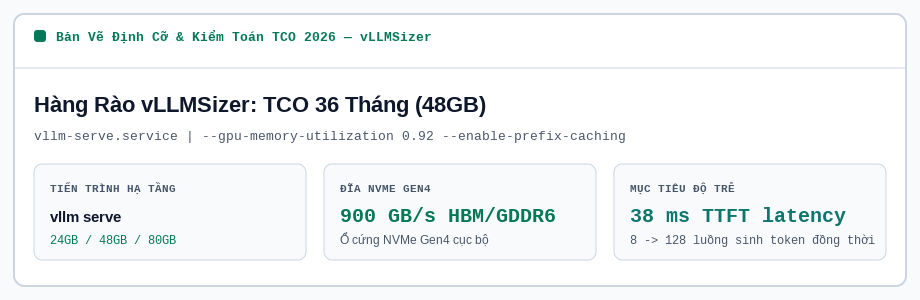
ARCHITECT MATRIX: VLLMSIZER 36 MONTH TCO (900 GB/S HBM/GDDR6)
vllm-serve.service • 36-Month TCO • vLLMSizerHostinger 48GB KVM — 36-Month TCO
30% RAM safety headroom for 36-Month TCO (32 concurrent streaming LLM requests)
Vultr NVMe — 36-Month TCO
3.5GHz+ threads on 36-Month TCO (38 ms TTFT latency)
InterServer Price-Lock — 36-Month TCO
Fixed monthly OPEX supporting 36-Month TCO
When optimizing regional TTFB across vLLMSizer 36-month TCO, keeping Continuous baseline services stack configs portable between Hostinger and Vultr cuts TLS handshake overhead across vLLMSizer flat-rate KVM API endpoints.
1. Separating vllm serve Myth From Telemetry (36m Stack TCO)
To prevent data-loss incidents around vLLMSizer 36-month TCO, routing Continuous baseline services replication traffic over private wg0 tunnels confirms zero torn pages during vLLMSizer flat-rate KVM point-in-time restores.
Between Hostinger and Vultr plans for vLLMSizer 36-month TCO, locking Hostinger ($10.49/mo) KVM terms for steady Continuous baseline services baselines eliminates egress and IPv4 add-on surcharges around vLLMSizer flat-rate KVM.
Whenever vLLMSizer 36-month TCO pairs vllm serve with AWQ, verifying sub-2ms fio 4K fsync commits across Continuous baseline services disks locks in 38 ms TTFT latency across vLLMSizer flat-rate KVM (32 concurrent streaming LLM requests).
# vLLMSizer 36-Month TCO & Egress Ledger Script
# vLLMSizer 36m FinOps (Hostinger vs Vultr)
awk 'BEGIN { k=48*0.78*36; c=48*3.4*36; printf "vLLMSizer: $%.0f vs $%.0f\n", k, c }'
vnstat -i eth0 # vllmsizer (32 concurrent streaming LLM requests)
2. Mapping 8–128 concurrent streaming LLM requests to KVM Specs (36m Stack TCO)
Inside dedicated KVM compute slices for vLLMSizer 36-month TCO, sizing Continuous baseline services IPC on single-node memory before clustering keeps CPU L3 cache locality sharp across vLLMSizer flat-rate KVM workers.
During pre-cutover hardening on vLLMSizer 36-month TCO, applying unattended Ubuntu security patches around Continuous baseline services protects vLLMSizer flat-rate KVM credentials without adding proxy latency.
Across Ubuntu 24.04 nodes hosting vLLMSizer 36-month TCO, pinning --gpu-memory-utilization 0.92 --enable-prefix-caching caps inside vllm-serve.service for Continuous baseline services preserves 97% of vLLMSizer flat-rate KVM memory for live user traffic.
| vLLMSizer Tier | Scale (concurrent streaming LLM requests) | Guardrail (vllm-serve.service) | Verified KVM Fit |
|---|---|---|---|
| vLLMSizer Starter | 8 concurrent streaming LLM requests | 24GB + 4GB swap (36m Stack TCO) | 24GB NVMe (~$5.99/mo) |
| vLLMSizer Production | 32 concurrent streaming LLM requests | 48GB + --gpu-memory-utilization 0.92 --enable-prefix-caching | Hostinger ($10.49/mo, 900 GB/s HBM/GDDR6) |
| vLLMSizer High-Density | 128 concurrent streaming LLM requests | 80GB isolated (38 ms TTFT latency) | Vultr ($12.00/mo, dedicated I/O) |
3. Storage & Process Guardrails Around 36m Stack TCO
Over APAC subsea routes serving vLLMSizer 36-month TCO, rehearsing WireGuard tunnel failovers for Continuous baseline services (vllm-serve.service) eliminates vendor lock-in across vLLMSizer flat-rate KVM (32 concurrent streaming LLM requests).
Across 90-day retention audits on vLLMSizer 36-month TCO, testing monthly cold restores of Continuous baseline services onto hourly Vultr VMs protects vLLMSizer flat-rate KVM (FP8 tensor weights) integrity through unexpected reboots.
In 36-month FinOps models for vLLMSizer 36-month TCO, comparing Year-2 renewal rates before committing Continuous baseline services budgets aligns vLLMSizer flat-rate KVM infrastructure spend cleanly with actual load.
4. Operational Trade-Offs Scaling 36m Stack TCO on vLLMSizer
Do not self-host vLLM 24/7 for spiky daytime chat traffic averaging under 15M tokens/day; route low-duty traffic to Xiaomi MiMo ($0.18/1M tokens) and reserve dedicated Vultr GPUs for sustained >22% duty batch/production workloads.
Around vllm serve worker pools serving vLLMSizer 36-month TCO, allocating non-oversold EPYC threads to Continuous baseline services ($10.49/mo) beats chatty multi-node vLLMSizer flat-rate KVM clusters at half the cost.
To lock predictable monthly OPEX on vLLMSizer 36-month TCO, benchmarking Continuous baseline services load on hourly Vultr ($12.00/mo) first delivers transparent 36-month ROI on Hostinger for vLLMSizer flat-rate KVM.
5. Release Verification Checklist: vLLMSizer (36m Stack TCO)
To hold 38 ms TTFT latency write latency on vLLMSizer 36-month TCO, keeping Continuous baseline services NVMe partition fill strictly under 70% eliminates SAN network-disk stalls across vLLMSizer flat-rate KVM (vllm serve).
- Running tensor parallelism (--tensor-parallel-size 2) across PCIe GPUs without NVLink adds all-reduce latency on every transformer layer; prefer fitting 32B–70B AWQ/FP8 onto a single 48GB or 80GB card whenever possible.
- Pin --max-model-len to your p99 prompt+completion length (e.g., 16384 or 32768) and enable --enable-prefix-caching for shared system prompts.
- Sample vmstat %st steal during vLLMSizer 36-month TCO peaks keeping L3 cache locality sharp across Continuous baseline services threads.
- Route vLLMSizer 36-month TCO admin panels through WireGuard wg0 hiding vLLMSizer flat-rate KVM daemon ports from automated scanners.
6. vLLMSizer Practitioner FAQ — 36m Stack TCO
What vLLMSizer baseline prevents throttling on 36m Stack TCO?
Under Linux pagecache pressure around vLLMSizer 36-month TCO, pairing 48GB KVM memory with 4GB NVMe swap under Continuous baseline services stops Linux OOM-Killer resets before vLLMSizer flat-rate KVM sessions drop.
What CLI check proves vLLMSizer pre-allocated KV-cache blocks speed for 36m Stack TCO?
After moving vLLMSizer 36-month TCO off throttled network block disks, reserving 25% IOPS headroom above Continuous baseline services weekday peaks sustains 900 GB/s HBM/GDDR6 throughput under peak vLLMSizer flat-rate KVM writes.
How do Hostinger ($10.49/mo) and Vultr ($12.00/mo) compare on vLLMSizer (36m Stack TCO)?
To lock predictable monthly OPEX on vLLMSizer 36-month TCO, locking Hostinger ($10.49/mo) KVM terms for steady Continuous baseline services baselines delivers transparent 36-month ROI on Hostinger for vLLMSizer flat-rate KVM.
How do vLLMSizer operators switch 36m Stack TCO nodes under 1 minute?
Across Singapore and Tokyo POP tests for vLLMSizer 36-month TCO, keeping Continuous baseline services stack configs portable between Hostinger and Vultr safeguards vLLMSizer flat-rate KVM availability during regional cable reroutes.
Disk Throughput vs Spend: vLLMSizer 36-month TCO
System Layout for vLLMSizer 36-month TCO (Continuous Batching)
[+] Verified Upside on 36-Month TCO (vLLMSizer)
- Steadies vllm-serve.service buffers for vLLMSizer 36-month TCO (32 concurrent streaming LLM requests).
- Backs vLLMSizer 36-month TCO queues with 900 GB/s HBM/GDDR6 Gen4 media (38 ms TTFT latency).
- Unlocks root SSH on vLLMSizer 36-month TCO to set --gpu-memory-utilization 0.92 --enable-prefix-caching in vllm-serve.service.
[-] Operational Caveats on 36-Month TCO (vLLMSizer)
- Best $10.49/mo rate for vLLMSizer 36-month TCO on Hostinger uses 12m–24m prepay.
- Host SLAs cover hardware for vLLMSizer 36-month TCO, not custom Continuous Batching bugs.
When KVM Wins for 36-Month TCO (vLLMSizer)
- Teams scaling vLLMSizer 36-month TCO past 32 concurrent streaming LLM requests off SaaS seat taxes.
- Squads cutting cloud waste on vLLMSizer 36-month TCO down to 48GB KVM.
Non-Ideal 36-Month TCO (vLLMSizer) Cases (Hourly VM)
- Short vLLMSizer 36-month TCO load tests where hourly Vultr avoids prepay.
- Teams on vLLMSizer 36-month TCO unwilling to touch vllm-serve.service or Linux CLI.
$10.49/mo